Trumps Pledge Fails to Yield Significant Trade Deal with China
May 15, 2026 • Al Jazeera
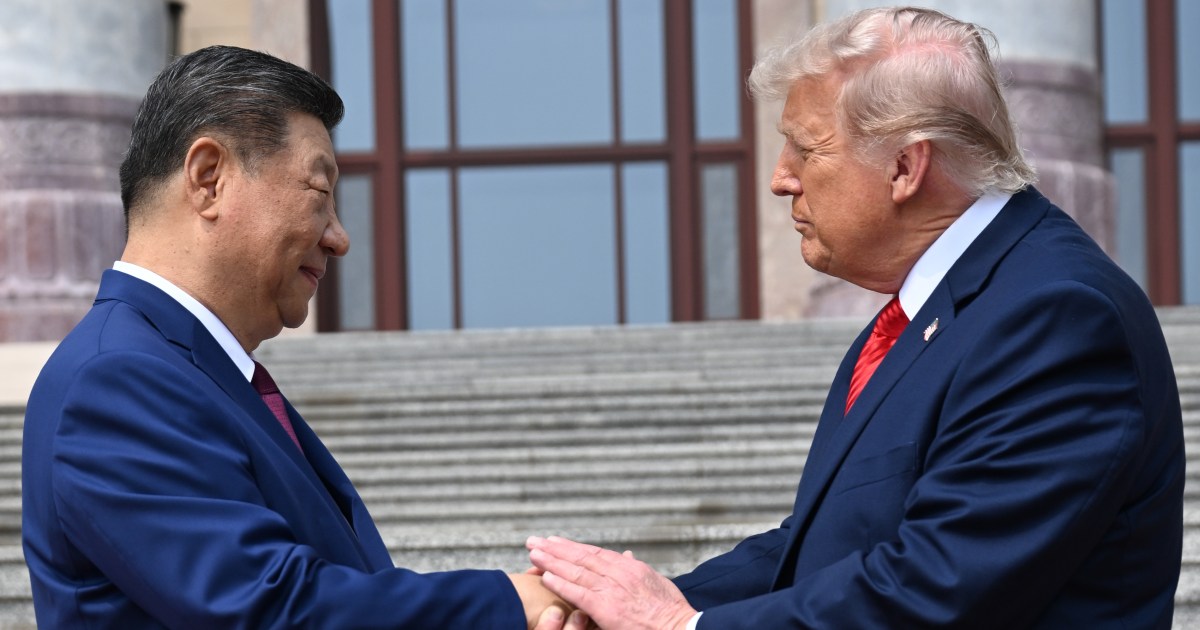
US President Donald Trump and Chinese leader Xi Jinping are set to conclude their two-day summit on Friday. The meeting comes after a one-year pause in their trade war, agreed upon in October. Trump has announced a delegation of top business executives, including Tesla’s Elon Musk, Apple’s Tim Cook, and Nvidia’s Jensen Huang, to accompany him.
Observers expect the talks to result in a stabilization of ties between the US and China, rather than significant progress. Claire E Reade, a senior counsel at Arnold & Porter, notes that “China does not trust the US” and wants to gain an advantage in long-term global competition. This limits what can be agreed upon.
The US side has flagged various business deals in the pipeline, including investments from China in companies led by Trump’s delegation members. In a prerecorded interview with Fox News, Trump stated that China would invest “hundreds of billions of dollars” in these companies. He also mentioned agreements on buying US oil and 200 Boeing aircraft.
During their meeting on Thursday, Xi expressed interest in purchasing more US oil, and the two leaders agreed that the Strait of Hormuz must remain open to support the free flow of energy. Taiyi Sun, an associate professor of political science at Christopher Newport University, suggests that a realistic opening up of the Chinese market will focus on sectors with economic complementarity.
Agricultural goods such as soybeans and beef, as well as high-value-added manufacturing products like Boeing aircraft, are seen as natural areas for expansion. China may also agree to a gradual opening of US firms’ access to financial services. However, progress in these areas is likely to be incremental rather than immediate due to political and institutional sensitivities.
The status of US export controls on advanced chips used to power AI remains a topic of discussion. The Trump administration has sent mixed signals on the need to control chip exports, with some restrictions tightened while others remain in place.
Source: Al Jazeera